Picture this. It’s 7:45 on a Monday morning, it’s pelting down, and you’re sitting in the driveway pressing a remote like you’re trying to win a quiz show. The gate sits there. Smug. Unmoved.
We’ve all been there, or we will be.
At Adonai Steel Fabrication, I’ve seen just about every way a gate can decide to stop cooperating. The good news is that most common gate opener problems are predictable. They usually give you warning signs, and a lot of them are easy to sort out.
So let’s go through them, one by one, like a mechanic walking you around a tired old ute.
Why Do Gate Openers Fail in the First Place?
Short answer: because they work hard and live outside.
Think about it. Your gate opener gets baked in summer, drenched in storms, covered in dust and used several times a day. Meanwhile, you probably haven’t thought about it since the day it was installed. That’s a lot to ask of one little motor.
Most failures come down to a few things:
- Age and wear. Moving parts wear out. That’s life.
- Weather. Sun, rain, salt air and humidity are tough on electronics and metal.
- Poor installation. A gate hung slightly out of line puts strain on everything.
- No maintenance. Even a tough opener likes a little attention now and then.
Keep those four in mind. They’ll come up again and again below.
Quick Reference: Gate Opener Problems at a Glance
| Problem | Likely Cause | DIY Fix? |
| Remote doesn’t work | Flat battery, pairing issue, weak signal | Often yes |
| Motor hums but gate won’t move | Jammed gate, failing capacitor, gear issue | Sometimes |
| Gate opens slowly or struggles | Dirty track, sagging gate, worn motor | Sometimes |
| Gate won’t close fully | Misaligned sensors, limit settings | Sometimes |
| Gate reverses on its own | Obstruction, dirty sensor, force setting too low | Often yes |
| Grinding or squealing noise | Dry parts, worn gears or chain | Sometimes |
| Gate stops working in the rain | Water in the control box or wiring | Call a pro |
| Solar-powered gate dies | Weak panel, dead battery, shade | Often yes |
| No power at all | Tripped switch, blown fuse, wiring fault | Call a pro |
1. The Remote Control Won’t Work
This is the number one complaint, and honestly, it’s often the easiest fix.
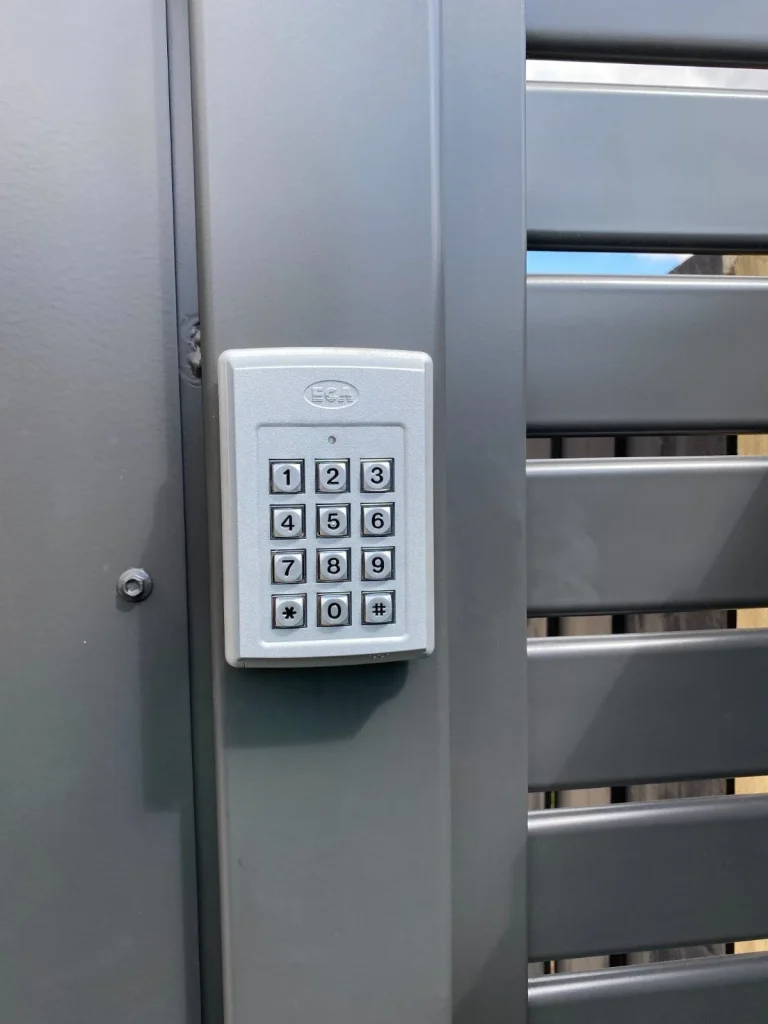
Before you blame the motor, check the boring stuff. Is the battery flat? Swap it. Does the wall button or keypad still work? If yes, the problem is almost certainly the remote, not the gate.
A few other culprits:
- Pairing lost. Sometimes a remote needs to be re-programmed to the receiver.
- Weak range. If you used to open the gate from the street and now you have to be at the letterbox, the remote’s battery or the receiver antenna may be on the way out.
- Interference. New electronics nearby can sometimes mess with the signal.
Pro tip: Keep a spare remote in the house, not in the car. I’ve met people who locked the only remote in the car, which was parked inside the gate. A fun afternoon was had by no one.
2. The Motor Hums, but the Gate Doesn’t Move
This one makes your stomach drop. You hear the motor working, so something is happening, but the gate stays put.
Here’s what could be going on:
- The gate is physically stuck. Check for a stone in the track, a branch, or a bit of rubbish. Seriously, look first.
- The release lever is engaged. Many openers have a manual release so you can open the gate by hand during a blackout. If it’s been left in manual mode, the motor will spin but the gate won’t follow.
- A failing capacitor. This small part helps the motor start. When it fades, the motor hums without enough oomph to move anything.
- Stripped gears. Over time, plastic or nylon gears wear down and lose their grip.
If it’s a simple obstruction or the release lever, you can fix it in a minute. If it’s the capacitor or gears, that’s a job for a technician. Please don’t poke around inside a powered motor. Not worth it.
3. The Gate Is Slow, Jerky or Struggling
A gate that used to glide and now lurches along like a shopping trolley with a bad wheel is telling you something.
Sliding gates often struggle because of a dirty or damaged track. Dirt, leaves and gravel pile up in there, and the wheels have to fight through it.
Swing gates usually have a different issue: sagging. Over time, heavy gates drop slightly on their hinges, and the opener has to push against that extra resistance. Sometimes the fault isn’t the opener at all. It’s the gate.
This is a good moment to mention something I tell people all the time: if a gate is hard to move by hand, no opener can fix that. The motor is only supposed to move a gate that already moves easily. If you can’t push it with a bit of effort, sort out the gate first.
Steel gates are especially good at this. A well-built, properly hung steel gate should swing or slide almost effortlessly. If yours doesn’t, that’s a sign something is out of line.
4. The Gate Won’t Close All the Way (or Open All the Way)
You press the button, the gate moves, and then stops a hand’s width short. Annoying, right?
This usually points to one of two things.
Limit settings are off. Every opener has a way to know where “open” and “closed” are. If those settings drift, or if someone bumped them, the gate stops too early or too late.
Safety sensors are misaligned. Many gates have a pair of photo-eye sensors that watch for things in the way. If they’re knocked out of line, even slightly, the gate thinks something is blocking it and refuses to finish the job.
A quick check: wipe the sensor lenses with a soft cloth and make sure both are facing each other squarely. Spider webs love these things. I once saw a gate fail every morning for a week because a spider had moved into the sensor like it was a rental.
5. The Gate Reverses on Its Own
You press the button, the gate starts to close, then pops back open like it changed its mind. Spooky? A bit. Broken? Not necessarily.
That’s actually a safety feature. Modern openers are designed to reverse if they sense something in the way. That protects people, pets and cars.
But sometimes it’s too sensitive:
- A dirty or blocked sensor
- A force setting that’s too low
- A real obstruction you haven’t spotted (like a garden edging or a bit of mulch)
- A sagging gate that creates extra resistance
Don’t be tempted to crank the force setting right up to “fix” it. That defeats the whole point of the safety feature. In Australia, gate safety matters, particularly around kids and pools, so if you’re unsure, get someone to check it properly.
6. Grinding, Squealing and Other Weird Noises
Gates make noise. That’s normal. But some noises are cries for help.
| Sound | What It Often Means |
| Squealing | Dry hinges, rollers or bearings |
| Grinding | Worn gears or a chain that needs attention |
| Clunking | Loose fittings or a misaligned gate |
| Rattling | Loose bolts or brackets |
| Buzzing with no movement | Electrical issue, possibly the capacitor |
A bit of the right lubricant on hinges and rollers solves a lot of squeaks. But grinding is different. That’s metal on metal, and it won’t fix itself. Leave it and you’ll be paying for a bigger repair later. Trust me, I’ve watched that movie.
7. Weather Troubles (Hello, Australia)
Our climate is tough on outdoor gear. Heat, humidity, storms, coastal salt air and the occasional dust storm all take their toll.
Heat can cause electronics to behave strangely and can make some materials expand slightly, which affects how a gate moves.
Rain and moisture can sneak into the control box. Water and electronics are not friends. If your gate misbehaves every time it rains, moisture is the first suspect.
Salt air (if you’re near the coast) slowly eats away at unprotected metal and fittings. This is where galvanised and powder-coated steel earns its keep.
Storms can cause power surges that fry control boards. A surge protector isn’t glamorous, but it can save you a nasty repair bill.
8. Solar-Powered Gate Openers Losing Power
Solar openers are brilliant for properties without easy access to mains power. Lots of rural and acreage homes use them. But they have their own quirks.
If your solar gate keeps dying, check:
- Is the panel dirty? Dust and bird droppings cut the charge more than you’d think.
- Is it shaded? A tree that has grown since installation can quietly steal your sunlight.
- Is the battery tired? Batteries don’t last forever. Most need replacing after a few years.
- Is the gate being used more than the system was designed for? A busy driveway can drain a small system.
A simple wipe of the panel is often the cheapest fix going.
9. No Power at All
Nothing. Not a hum, not a click. Just silence.
Start with the obvious: has the power been cut or has a safety switch tripped inside the house? Check the fuse box. If everything looks fine there, the issue might be a blown fuse inside the opener or a wiring fault.
Here’s where I’ll be firm: mains-powered gate openers involve 240 volt wiring, and in Australia that work needs to be done by a licensed electrician. It’s not a place for guesswork. If there’s no power and the simple checks don’t solve it, call someone qualified.
DIY Fix or Call a Professional?
I’m all for having a go at the easy stuff. But knowing where to stop is just as important.
Reasonable DIY jobs:
- Replacing remote batteries
- Wiping sensors and solar panels
- Clearing tracks and debris
- Lubricating hinges and rollers
- Checking the manual release lever
Leave these to a pro:
- Anything involving mains wiring
- Replacing control boards or motors
- Repairing or re-hanging a heavy gate
- Adjusting safety force settings
- Persistent faults that keep coming back
If you’re nodding at the second list, no shame in that. A good technician will find the problem faster than you will, and you’ll keep all your fingers.
How to Stop Problems Before They Start
Prevention is boring, but it works. Here’s a simple routine:
- Once a month: Wipe the sensors, clear the track, and watch the gate move. Does it look smooth?
- Every few months: Lubricate moving parts and check for loose bolts.
- Twice a year: Test the safety reverse and the manual release.
- Once a year: Get a professional service, especially if the gate is heavy or used daily.
It takes a few minutes here and there, and it can add years to the life of your opener.
When Is It Time to Replace the Opener (or the Gate)?
Sometimes repairs just aren’t worth it. Here are some signs it’s time to move on:
- The parts are no longer made
- Repairs keep piling up
- The opener is more than ten to fifteen years old and struggling
- The gate itself is bent, rusted or badly worn
And here’s a thought that often gets missed: the opener is only as good as the gate it’s moving. A solid, well-fabricated steel gate makes everything easier, from smoother movement to less strain on the motor. If your gate is a wonky old thing that’s been patched several times, a new custom gate might solve problems an opener never could.
Frequently Asked Questions
Why does my gate opener keep stopping halfway?
Usually it’s a sensor issue, an obstruction, or limit settings that need adjusting. Clean the sensors and check the gate’s path first.
Why is my gate opener making a noise?
Squeaks usually mean dry parts. Grinding often means worn gears or a chain. If the noise is new, get it checked.
How long do gate openers last?
It depends on the type, usage and care, but many last around ten years or more with decent maintenance.
Can I open my gate manually if the power goes out?
Most openers have a manual release. Check your manual so you know where it is before you need it.
Is it safe to fix a gate opener myself?
Simple jobs like cleaning and battery swaps are fine. Anything electrical, or any adjustment to safety settings, is best left to a licensed professional.
Final Thoughts
Gate openers are a bit like car batteries. You don’t think about them until they fail, and they always fail at the worst time. But most common gate opener problems come with warning signs, and a little regular care goes a long way.
Start with the simple checks. Clean what you can, listen to what your gate is telling you, and don’t ignore the strange noises.
And if you’re stuck, call someone who does this for a living. At Adonai Steel Fabrication, we build and repair gates every day, and we’re happy to take a look. Whether you need a fix, a tune-up or a brand-new steel gate that moves the way it should, get in touch for a chat.
Your Monday morning self will thank you.