Melbourne has a lot of hills. Anyone who has parked on a steep street in Kew, Warrandyte or Eltham, or watched a delivery driver go a bit pale reversing up a driveway, knows this.
Now picture putting a gate on that driveway.
A flat driveway is easy. A sloped one makes a gate behave like a stubborn toddler. It scrapes the ground, swings into the hill, or refuses to roll. I’ve seen all three, and they usually trace back to one mistake: someone picked the gate before they looked at the slope.
Here’s how to avoid that. By the end you’ll know which gates for sloped driveways in Melbourne suit your property, what drives the cost, and what to ask before you sign anything.
Why Sloped Driveways Make Gates Tricky
On a flat driveway, a gate has one job: open and close. On a slope, it has to deal with gravity too.
- Swing gates sweep an arc. On a rising driveway, the bottom edge can hit the ground halfway through that arc.
- Sliding gates need a level, straight run. If the ground tilts, the gate can roll under its own weight or jam.
- Automatic openers work harder on slopes. Weight and angle both load the motor.
- Water runs downhill. Gates, posts and tracks sit in a drainage path, and standing water causes rust and grit in the works.
None of this means you can’t have a good gate. It means the design has to follow the slope, not ignore it.
The Best Gates for Sloped Driveways in Melbourne
Here are the main options, with the honest pros and cons of each.
1. Swing Gates (Single or Double)
These are the classic hinged gates. They can work well on slopes, but only with a few tweaks:
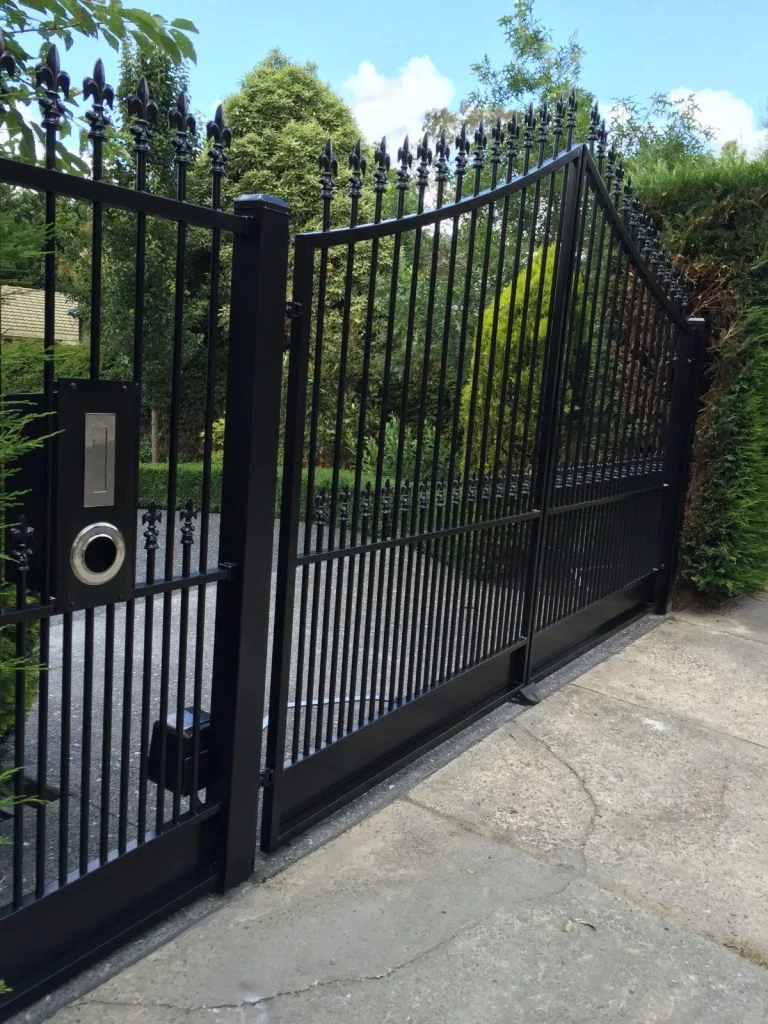
- Rising hinges lift the gate as it opens, so it clears a rising driveway.
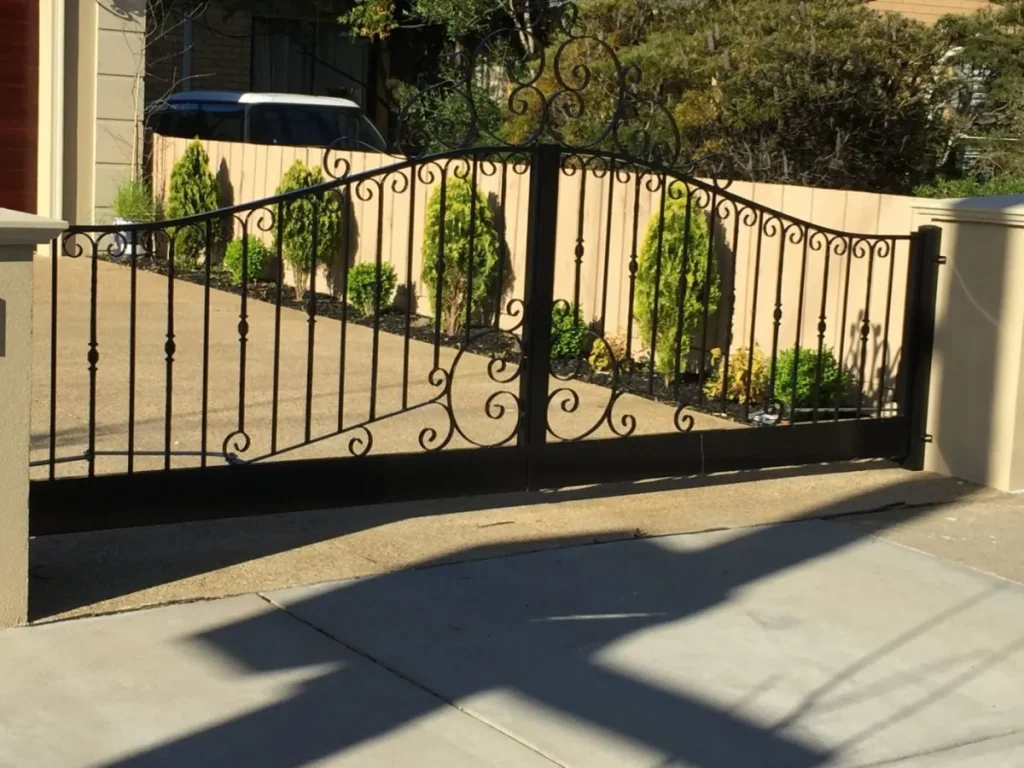
- Raked or stepped bottoms, where the bottom edge follows the ground line, let the gate close neatly against uneven ground.
- Gates that open inward and uphill need clearance. Measure it, because it’s often tighter than you’d guess.
Best for: gentle to moderate slopes where you have room for the swing.
Watch out for: steep driveways where the gate would have to open into the hill.
2. Sliding Gates
Sliding gates are popular in Melbourne, especially in tight inner suburbs where there’s no room for a swing. On a slope, you have two choices:
- Level the track. The gate runs on a flat track, and the gate frame is shaped to follow the ground below it. It looks neat and works reliably.
- Run an angled track. This is possible on gentle slopes, but the motor, track and wheels need to be rated for it, because a heavy gate on a tilt wants to keep going.
Best for: narrow frontages and streets where cars park close.
Watch out for: needing a clear, straight run beside the gate, equal to the gate’s width or more.
3. Cantilever Gates
A cantilever gate hangs from rollers on posts and never touches the ground. That’s a big deal on a slope, because there’s no track to level and no bottom edge to catch on uneven concrete.
Best for: uneven or steeply sloping driveways, and driveways where dirt, leaves or gravel would clog a track.
Watch out for: it needs a lot of side space (roughly the gate width plus a counterweight section), and the posts have to be properly engineered and footed.
4. Bi-Fold Gates
Bi-fold gates fold in half as they open, so they need less room than a full swing gate. They suit awkward, narrow sites where sliding and swinging both struggle.
Best for: tight spots with limited side and front clearance.
Watch out for: more moving parts means more to maintain, and they’re not ideal on very steep ground.
Gate Types at a Glance
| Gate type | Slope suitability | Space needed | Maintenance | Rough comparison |
| Swing (with rising hinges) | Gentle to moderate | Swing arc in front or behind | Low | Often the most budget-friendly |
| Sliding (levelled track) | Gentle to moderate | Straight run beside gate | Medium (track cleaning) | Mid to higher |
| Cantilever | Moderate to steep | Long side run, no track | Low to medium | Often the priciest |
| Bi-fold | Gentle to moderate | Small side and front space | Medium | Mid to higher |
I’ve left out dollar figures on purpose. Prices vary a lot with width, steel thickness, finish, automation and site prep. Be wary of anyone who quotes a number without seeing your driveway.
So, How Steep Is Too Steep?
I get asked this all the time. There’s no single answer, and it isn’t only about the gate.
Councils in Melbourne have their own rules about driveway gradients, and the Australian standards for driveways and parking generally steer designs away from very steep ramps. As a rough guide, many driveways stay within about 1 in 4 (25%), with gentler sections where the driveway meets the street. Your council or building surveyor has the final word, so check with them before you plan anything. Rules differ between councils and between properties.
On the gate side, the practical test is simple: can the gate open, close and stay put without fighting the ground? If the answer is “only just”, pick a different style, such as a cantilever, or reshape the driveway.
Steel Is Your Friend Here
I’m a bit biased, since steel is what we work with at Adonai Steel Fabrication, but there’s a reason it suits Melbourne slopes.
- Strength without bulk. A steel frame can be made rigid enough to handle a long, heavy gate on uneven ground.
- Custom shapes. A fabricator can cut and weld the bottom edge to match your exact slope. A mass-produced gate can’t do that.
- Weather resistance. Hot-dip galvanising followed by powder coating protects against rust, which matters in a climate that goes from 40-degree days to wet, cold weeks.
- Fire sense. If you’re in a bushfire-prone area (think the Yarra Ranges, Macedon or the outer north-east), non-combustible materials like steel are a smart choice. Your local requirements depend on your property’s bushfire rating, so check that too.
Timber looks lovely, but on a slope it swells, warps and sags. I’ve seen a nice timber gate drop at the latch end within two winters. Steel doesn’t do that.
Automatic or Manual?
If you’re pulling up a steep driveway in the rain, getting out to open a gate is no fun. That’s why most people on slopes go automatic. Here’s what to know:
- Motor rating matters. Choose an opener rated for the weight of your gate and the slope. Underpowered motors burn out early.
- Safety features are non-negotiable. Look for obstruction sensing, photo-eye sensors, and a manual release for power cuts.
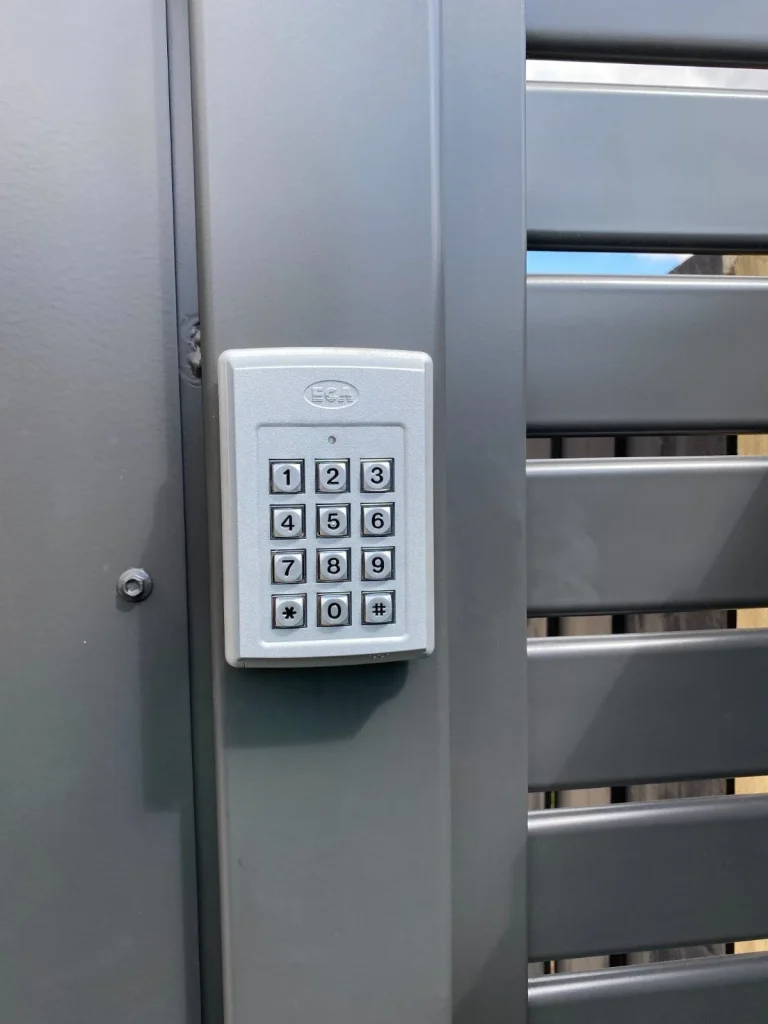
- Think about the remote. Phone apps, keypads and intercoms are all common. Pick what your household will actually use.
- Plan the power. Running cable under a sloped driveway takes planning, so sort it before the concrete goes down, not after.
Automatic gates are also subject to Australian safety standards, so use a licensed installer and ask what the installation complies with.
Don’t Forget the Ground Under the Gate
This is the part nobody gets excited about, and it’s where many gates fail.
Melbourne has a lot of reactive clay soil, which swells when wet and shrinks when dry. On a slope, that movement can tilt posts, throw off alignment, and make a perfectly good gate sag.
Good fabricators and installers will:
- Set posts in properly sized concrete footings, deep enough for your soil
- Plan drainage so water doesn’t pool at the base of posts or inside a track
- Leave allowance for movement where the soil is known to shift
If a quote doesn’t mention footings, ask about them.
What to Ask Before You Hire Anyone
Here’s my short list. Bring it to your first meeting.
- Will you visit and measure the slope on site? (If they won’t, walk away.)
- Which gate style do you recommend for my gradient, and why?
- Is the gate custom made to fit my driveway?
- How will you protect it from rust? Galvanising and powder coating is a good answer.
- What’s included in the quote? Posts, footings, automation, electrical work, and installation.
- Do you handle council or permit questions, or do I?
- What warranty do you offer, and on which parts?
A good fabricator answers these without squirming. If you get vague replies, take it as a hint.
A Quick Story
A while back, a homeowner in the hills called me about a gate that kept scraping a deep arc into their driveway. They’d bought a standard swing gate online and had it fitted by a handyman. It looked great on day one. By month three, it had gouged the concrete and wouldn’t latch.
The fix wasn’t dramatic. We rebuilt the gate with rising hinges and shaped the bottom edge to follow the slope. Same driveway, same owner, completely different result.
That’s the point of this whole article. The gate that works on a slope is the one designed for that slope. Everything else is guesswork.
Frequently Asked Questions
Can you put a sliding gate on a sloped driveway?
Yes, with the right setup. A levelled track works well on gentle slopes. On steeper ground, a cantilever gate is usually a better call because it needs no track.
What is the best gate for a steep driveway in Melbourne?
For steep or uneven driveways, cantilever gates are often the most practical because they don’t touch the ground. Swing gates with rising hinges can also work if you have the clearance.
Do I need council approval for a driveway gate?
It depends on your council and your property. Fence and gate height, location and overlays can all matter. Check with your local council before you build.
How much do gates for sloped driveways cost?
It varies by gate type, size, material, automation and site work. Sloped sites usually cost more than flat ones because of the custom fabrication and groundwork. Get a quote after a site visit.
Are steel gates better than timber for slopes?
In most cases, yes. Steel handles weight, weather and movement better, and it can be shaped to match your driveway.
Can an automatic gate opener handle a slope?
Yes, as long as it’s rated for your gate’s weight and the angle. Underpowered openers fail early, so be specific with your installer.
How long does it take to make and install a custom gate?
It depends on design, workload and weather. Ask for a realistic timeline up front, including time for footings to cure.
Final Thoughts
Gates for sloped driveways in Melbourne don’t have to be a headache. Look at your gradient, work out how much space you have, and choose the style that suits both. Steel gives you strength and a custom fit, and good footings and drainage keep it working for years.
If you’re planning a gate and aren’t sure which way to go, have a chat with the team at Adonai Steel Fabrication. Tell us about your driveway, send a few photos, and we’ll talk through what will actually work, with no pushy sales pitch and no scraped concrete.
Your driveway has a slope. Your gate should respect it.